Shoulder Titles

Sleeve Tradition Insignia

The wearing of insignia on the sleeve is a tradition that originated during the British period, as the nucleus of the new Belgian Army after the Second World War was formed in Great Britain. The British period in the Belgian Army lasted from 1942 until 1960, when the American-style LANDCENT organization was adopted. LANDCENT (Land Forces Central Europe) was NATO’s former Allied Land Forces Central Europe headquarters in Heidelberg, Germany, and symbolized the integration of American forces into NATO’s permanent command structures.

Until the end of the Battle Dress era on 1 January 1980, major formations were identified by sleeve badges: the Corps and Division of the Intervention Force, as well as the three military regions of the Home Forces. These badges shared recurring symbolism, most notably either the head of a heraldic lion or a standing lion.
Overview of Heraldry Zones on Uniforms Clickable areas on a uniform, with codes for the various heraldic elements. S – Shoulder title (max. 2) S V3 – Brevet zone (max. 1) V3 V4 – Brevet zone (max. 1) V4 F2 – Brevet zone (max. 1) F 2 F1 – Rank, Crown, RSM, CSM, Corporal F 1 F1 – Rank, Crown, RSM, CSM, Corporal F 1 E1 – Honours and decorations E1 V7 – Brevet zone Para B V7 S – Shoulder title (max. 2) S W – Shoulder zone W W – Shoulder zone W K – Collar patch or brevet zone K K – Collar patch or brevet zone K V6 – Brevet zone (max. 1) V6 V5 – Name tag, Brevet zone (max. 1) V5 V2 – Brevet zone (max. 1) V2 V1 – Brevet zone (max. 1) V1 U1 – Unit hanger U1

Table of contents

The Piron Brigade Shoulder Title

In September 1942, Major Staff Officer Jean Piron assumed command of the 1st Fusilier Battalion when the Belgian forces in Great Britain were reorganized. Two groupings were established: Grouping I, under Major Piron, containing the operational units, and Grouping II, consisting of administrative services and the depot. From that moment onward, neither the 1st nor the incomplete 2nd Fusilier Battalion continued to exist as such. Instead, three motorized units were attached to Grouping I. On 21 January 1943, this formation became the First Belgian Independent Group (commonly known as Brigade Piron).

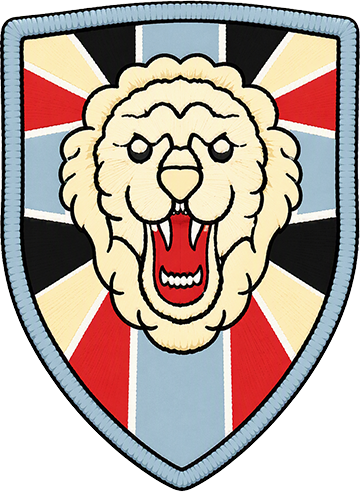
In 1943, during a meeting, Lieutenant Colonel Piron proposed the creation of a badge in the style of British formation signs. A lion’s head, similar to that displayed on the Belgian Army steel helmet worn from 1915 to 1940, was immediately suggested and placed on an inverted triangle in the national colours.

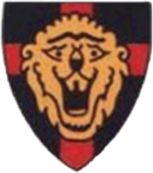
When Brigade Piron crossed the Belgian border near Rongy on 3 September 1944, it was discovered that the resistance movement known as the Secret Army was already wearing a very similar badge. A new badge was therefore quickly designed for the 1st Brigade, inspired by the insignia of the British 21st Army Group: a yellow lion’s head on a red Latin cross, all placed on a black shield. In June 1945, this badge was adopted by the 1st Infantry Division of the Belgian occupation forces in Germany.

Zone S | Left

The COMMANDO Shoulder Title

The Belgian 4th Troop of No. 10 (Inter-Allied) Commando was established on 27 July 1942 in Great Britain under the command of Captain Georges Danloy. The unit, consisting of approximately 100 volunteers, underwent intensive training at Achnacarry, Scotland, where it earned the right to wear the green beret.

From December 1943 onward, it became the first Belgian land unit since 1940 to engage in combat, notably in Italy (Sangro and Garigliano), later in Yugoslavia, and during the liberation of Walcheren in the Netherlands. By the end of the war, the Belgian contingent had expanded with the creation of No. 9 and No. 10 Troops, becoming the largest non-British component within the Commando force. In May 1945, the unit was reorganized as the Commando Regiment.

In addition to the well-known Combined Operations Badge, Belgian commandos wore the shoulder title COMMANDO or 10 COMMANDO. Initially featuring white letters on a khaki background, it was replaced shortly after 1950 by the black-backed version still used today.

Zone S | Left & right

The COMMANDO SIGNALS Shoulder Title

Since 26 January 2023, personnel of 6 Group CIS have worn the shoulder title COMMANDO SIGNALS. The unit is historically linked to the 4th Troop of No. 10 Inter-Allied Commando and perpetuates this tradition, notably through the wearing of the green beret.

A new beret badge was also introduced, highlighting the connection between the CIS community and the Paracommando tradition. The wearing of the shoulder title and Paracommando insignia reflects the integration of 6 Group CIS within the Special Operations Regiment.

Historically, communications specialists formed part of the Commando Brigades and were employed flexibly among different units according to operational requirements.

An interesting website to visit: Signal Troops of the Special Service (Commando) Brigades

Zone S | Left & right

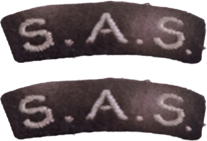
The S.A.S. Shoulder Title

In May 1942, an independent Belgian parachute company was created in the United Kingdom. In the spring of 1944, the company was transformed into a Special Air Service (SAS) Squadron and integrated into the British-commanded SAS Brigade, alongside two British and two French SAS battalions.

Over time, shoulder titles bearing the designation “S.A.S.” came into use within the SAS Brigade and were also worn by Belgian SAS personnel.

Zone S | Left & right

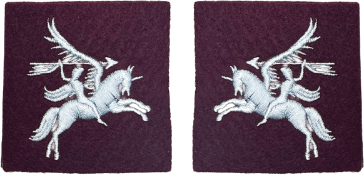
Airborne Shoulder title

In May 1942, an independent Belgian parachute company was established in the United Kingdom. In the spring of 1944, it became an SAS Squadron and joined the SAS Brigade under British command.

The SAS Brigade formed part of the Army Air Corps (AAC), the organization responsible for the administration of British airborne forces, including both the Parachute Regiment and the Glider Pilot Regiment. Consequently, AAC dress regulations also applied to the Belgian SAS unit after its integration into the brigade.

These regulations prescribed the wearing of the maroon beret (already unofficially worn by Belgians since 1942) and airborne sleeve insignia. The insignia consisted of a pair of maroon squares bearing light-blue silhouettes of Bellerophon riding the winged horse Pegasus from Greek mythology. Separate mirrored versions existed for the left and right sleeves.

Belgian SAS personnel wore these airborne insignia following their integration into the SAS Brigade in 1944.

Zone S | Left & right

The Korea Badge

Since 1 September 1955, personnel of 3 Para have worn on their left sleeve the badge of the Belgian Volunteer Corps for Korea (1950-1953).

The badge depicts a lion’s head on a blue cross, symbolizing the United Nations forces that fought in the Korean War, with the Belgian national colours displayed between the arms of the cross.

Zone S | Left